

Guides
How to start a play cafe
The smallest format we write about, and the only one with two businesses in it: a cafe that has to work on its own numbers, and a play area that has to be watchable from a table.
A hybrid, and the hybrid is the whole point
Our own definition: a cafe atmosphere combined with an indoor play area designed for children, where parents and caregivers can have coffee, snacks and conversation while keeping an eye on their kids. Unlike a traditional cafe, it prioritizes child-friendly design — soft play, sensory zones, structures built for the youngest.
The appeal, in our own words, is that it meets two needs at once: a relaxing environment for adults and an enriching play space for children. That is also the difficulty. Two businesses share one room, one roster and one lease, and the format fails when either half is treated as decoration for the other.
Their business plan list is beside this, in their order. It is a shorter list than the other three guides ask for, which fits — this is the format somebody opens without a development team behind them. Restaurants and play cafes is the sector page, and our piece on who benefits from indoor play is where the format first appears in our writing.
- Market research
- Competitive analysis
- Revenue streams
- Budget and costs
- Legal requirements
One thing left out of this page on purpose. The FAQ at the foot of our own play cafe post answers three questions about trampoline parks — padding and netting, custom trampoline layouts, attraction mixes. The block was pasted in from another post and never rewritten.
It is not reproduced here, because repeating it would spread it. Everything else in that post is carried whole, and the fault is recorded in our migration notes so it can be fixed at source rather than quietly patched over.
Seating that can see, and a floor that can be cleaned
Our own design advice for this format is short and almost all of it is about the adults: thoughtful decor that makes the room a community hub rather than a playground with chairs, cozy seating for parents, a section for drinks, coffee and light food — and clear sightlines from the seating to the play area, which our guide calls crucial.
The equipment half is three words: safe, durable, and easy to clean and maintain. A play cafe runs food and play in the same room, so the cleaning routine is not an operations footnote — our cleaning guide and maintenance are where it lives, and a ball pit is the single item that most repays deciding about in advance.
And the numbers beside this are borrowed. We publish none for play cafes; the figures are from our restaurants guide, which is the nearest format we have measured — a contained toddler area from 100 to 150 square feet, a multi-level structure from 300 to 500 with nine to ten feet of ceiling. A good place to start, not a specification for your lease.
The same guide gives the sightline rule its name: the goldfish bowl. Parents want to relax but never stop parenting, and if they have to stand up to check on a child, the benefit of the room is gone. Glass or half-height boundaries, and a line of sight from where the coffee is.
- Toddler area
- 100–150 sq ft, contained soft play
- Multi-level
- 300–500 sq ft, 9–10 ft of ceiling
- Published for
- Restaurants, not play cafes
Our own figures, published for restaurants. Nothing on this page is a measurement of your building.
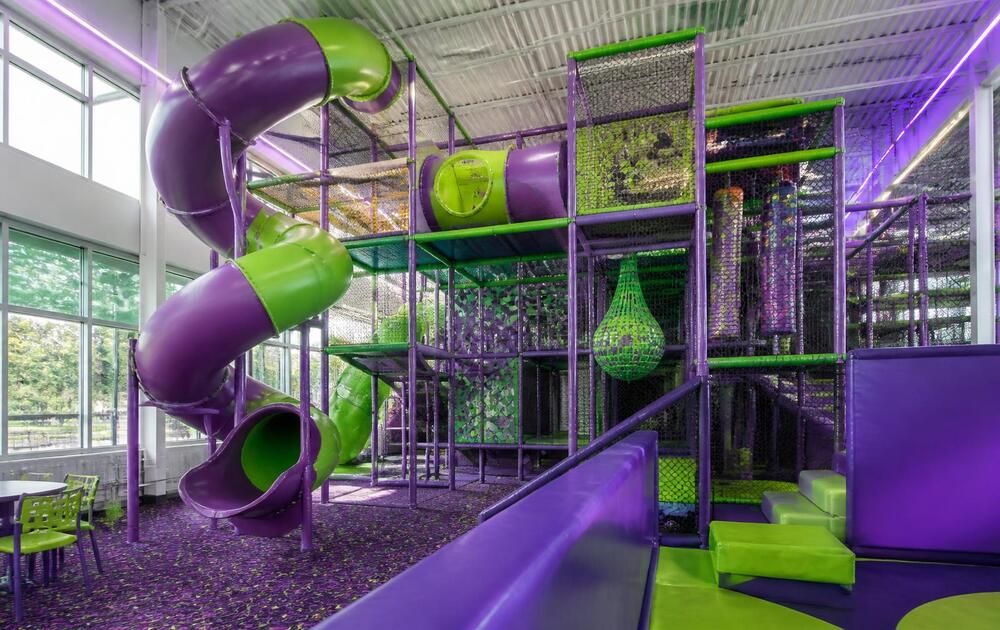
Test them against your roomWhat goes in the play half: toddler zones for the age this format actually serves, sensory play because it is ground-level and quiet, and a theme if you want to be remembered — our themed design post is behind that, and soft play is the section. Equipment that meets the standards is not optional: what the soft play standards ask applies in a cafe exactly as it does in a park. The order to make these decisions in is the design guide.
Three roles, and the one that decides the format
Our own guide names all three and is clear that training covers more than the job: child safety protocols, cleaning procedures and customer interaction.
Play attendant
TheirsOur own guide names the role: supervising children, enforcing the safety rules and helping parents. Some play cafes include one — and whether yours does is the decision that changes everything else in this guide.
Cafe staff
TheirsPreparing food and drink while maintaining cleanliness and efficiency. In a room where the floor is also a play surface, the cleaning half of that sentence is doing more work than it does in an ordinary cafe.
Management
TheirsDaily operations, scheduling and customer relations. In a two-business format, scheduling is the hard part: the cafe peaks at a different hour from the play area, and one roster has to cover both.
The part that is ours: whether you employ a play attendant is the decision the rest of the room is designed around. With one, the play area can be bigger, less visible from every table, and busier. Without one, every square foot of it has to be watchable from a seat with a coffee on the table — which is a smaller, simpler, cheaper room, and a legitimate way to run the format. What it is not is an accident. Decide it before the layout, because the layout is drawn around the answer, and staff training is what turns the answer into a routine.
Four ways in, and one of them is not weather-dependent
Website and social
TheirsShowing the things that make the room different — a themed play zone, birthday packages, seasonal events. In this format the photograph that sells it is a parent sitting down.
Local partnerships
TheirsSchools, daycares and parenting groups. Our own line is that parents share their favorite spots with friends, and that word of mouth can be as powerful as paid advertising.
A grand opening
TheirsFree play sessions, discounts or entertainment to draw families in on day one. It is also the cheapest market research you will ever run: watch which age group actually arrives.
Memberships
Theirs and oursMonthly or annual unlimited play, which our guide recommends for recurring revenue and loyalty. The part that is ours: it is the only line in this format that does not move with the weather, and it is what makes a quiet February survivable.
All four are our own, from the play cafe guide. The membership point matters to the arithmetic as much as to the marketing: it lands in the other-spend and occupancy fields of the payback calculator, which are the two that move the answer most. Party and F&B zones is the other revenue half of this format, and a feasibility conversation is where a catchment gets tested before a lease is signed.
The other guides
5 pages
Attraction Mix & Space Planning
How to divide a footprint between attractions, and what each one needs.
How to Start an FEC
From market research to opening day, the steps an FEC takes.
How to Start a Trampoline Park
Site, equipment, permits and staffing for a new trampoline park.
How to Start an Indoor Playground
Research, funding, permits and design for a first play center.
Indoor Playground Design Guide
Laying out a play space around sightlines, age groups and traffic flow.


The next step
Send the building, get a line-item estimate
Footprint, ceiling height and opening target is enough to start. You get a priced scope, not a brochure.
Talk to somebody
864-477-1126Request an EstimateOr send a floor plan and we will come back with a priced scope.